Not every important space in Brussels is one where laws are voted on or funding calls are approved. There are others, less visible, where the conversation begins to take shape: which topics enter the agenda, what evidence is brought to the table, and which kinds of solutions start gaining political traction.
One of those spaces is the European Parliament’s Panel for the Future of Science and Technology, better known as STOA.
In practice, STOA is the body that helps the European Parliament better understand major scientific and technological issues that may eventually have political, social, economic, or regulatory impact. Its role is not to fund projects or launch calls, but to bring expert knowledge closer to Members of the European Parliament so they can make decisions based on stronger scientific evidence.
When an issue reaches STOA, it stops being only a technical or academic matter. It becomes part of a European political conversation. And when Galician research appears in that conversation, the message changes as well: Galicia is not only receiving European policies — it can also help shape them.
The FIREPOCTEP+ Case
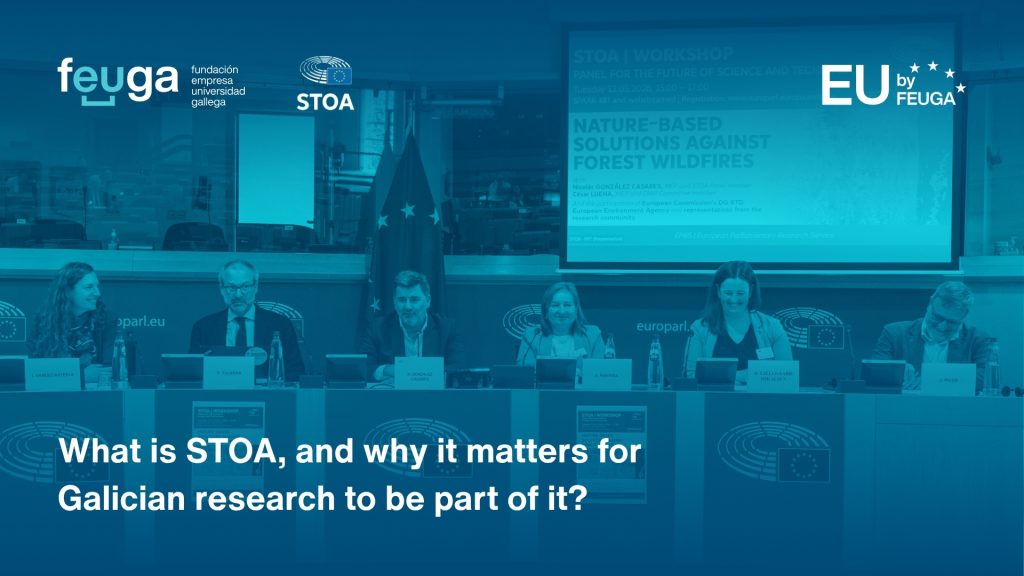
On 12 May, the European Parliament hosted the workshop “Nature-Based Solutions Against Forest Wildfires”, focused on the role of nature-based solutions in tackling forest fires.
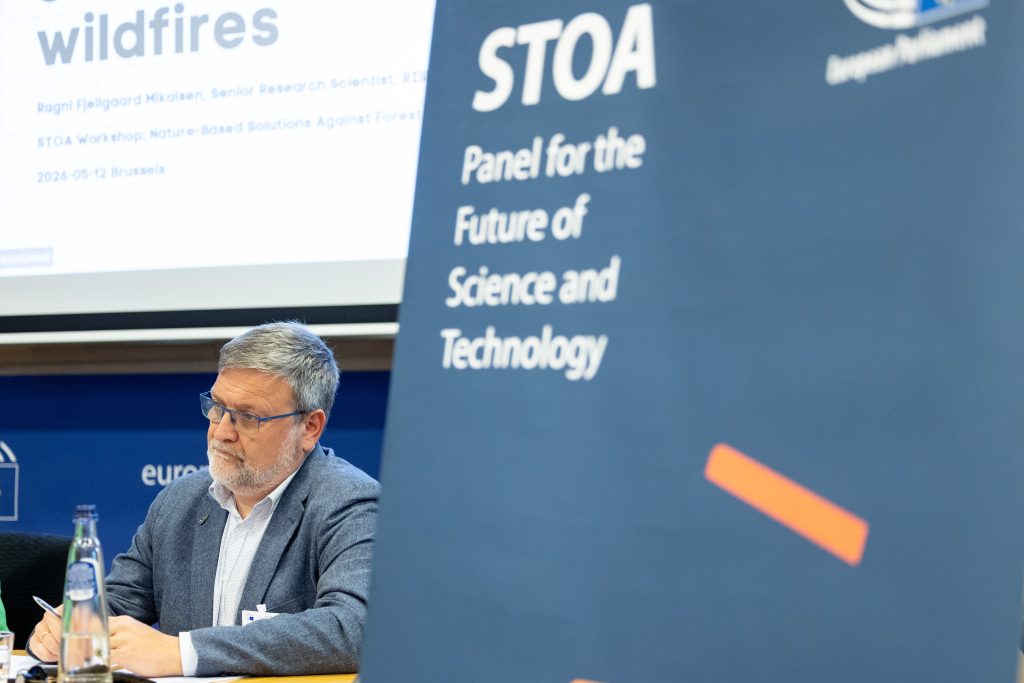
Among the speakers was Juan Picos, professor at the Universidade de Vigo and coordinator of the FIREPOCTEP+ project, in which FEUGA also participates. His intervention presented to European representatives the work being carried out on the ground to improve prevention, management, and resilience against large wildfires.
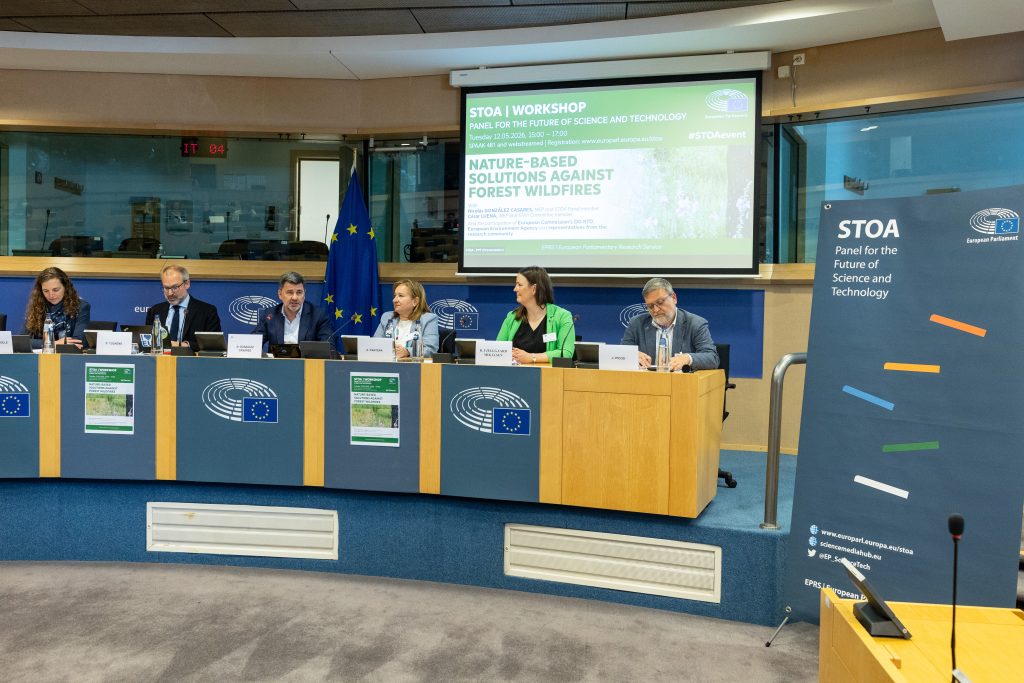
The event brought together representatives from the European Environment Agency, the European Commission, universities, and research centres linked to forest management and climate adaptation. Held at the European Parliament as part of STOA’s activities, it served as a platform for discussing emerging challenges and approaches related to forest fires.
FIREPOCTEP+’s participation made it possible to showcase the experience and knowledge developed in Galicia, together with organisations from Spain and Portugal under the cross-border cooperation framework promoted by the Interreg POCTEP programme, in a setting closely connected to European debates on resilience, territory, and prevention.
Why Are Wildfires Entering This Conversation Now?
In Europe, forest fires are no longer understood solely as a firefighting issue. Increasingly, they are seen as a challenge linked to territory, climate, forest management, rural economies, and adaptation.
The workshop’s approach made this clear: wildfires are becoming more intense and geographically widespread due to climate change and land-use changes. The response can no longer focus only on improving firefighting capacity — it must also include prevention, landscape planning, and resilience.
This is where nature-based solutions come in: ecosystem restoration, diversified landscape management, vegetation fuel reduction, grazing, agroforestry mosaics, strategic management zones, and the recovery of traditional land uses that can help reduce risk.
For Galicia, this is far from a distant debate. It is almost a description of many of our own challenges: forests, rural abandonment, the urban-forest interface, climate change, pressure on firefighting services, and the need to reconcile prevention, biodiversity, and economic activity.
Why STOA Matters for the Galician Ecosystem
For universities, technology centres, companies, and innovation organisations, STOA matters because it acts as a political-scientific radar.
The topics it addresses are not random. They are linked to European priorities: artificial intelligence, the Green Deal, quality of life, emerging technologies, social challenges, the economy, regulation, and sustainability.
Being close to these debates helps stakeholders understand where Europe is heading before those priorities are translated into funding calls, programmes, or new regulatory requirements.
In this case, the message is clear: wildfire prevention, territorial resilience, and nature-based solutions are gaining space on the European agenda. And Galicia has knowledge, experience, and pilot territories to contribute.
Where FEUGA Comes In
In European projects such as FIREPOCTEP+, good science alone is not enough. Coordination, knowledge transfer, communication, connections with local stakeholders, and the ability to position results within European networks are also essential.
This is precisely the layer of support FEUGA provides: ensuring that the knowledge generated in Galicia and through cooperation with other territories does not remain confined within the consortium, but instead circulates, becomes understandable, and reaches spaces where it can have real impact.
This is where FEUGA’s Brussels office becomes especially valuable. Having a presence in the European capital makes it possible to closely follow political debates, identify opportunities, understand where priorities are heading, and connect the work of the Galician ecosystem with European institutions, networks, and forums.
The participation of Galician research in STOA fits perfectly within this logic. It is not only about implementing a European project, but about ensuring that the project has a broader trajectory. That it reaches spaces where public policy is discussed. That it positions Galicia not only as a territory with needs, but also as one capable of contributing advanced and transferable knowledge and solutions.
Conclusions
The participation of Galician research in a STOA workshop is a signal for the entire Galician innovation ecosystem. It means that the work being carried out in Galicia can reach high-level European forums. It means that European projects do not only implement activities but can also generate impact and influence the political agenda of the future.
Ultimately, the key is understanding that, in Europe, many opportunities begin before the funding call itself. They begin when a problem enters the agenda, when a solution is considered relevant, and when a territorial experience manages to be heard. And for this to happen, expert knowledge-transfer actors are needed to facilitate the connection between science, territories, and European institutions.
FIREPOCTEP+ has enabled part of Galician research to enter that conversation. And STOA is one of those places where it is worth being.