The project, funded by Horizon Europe, brings together 17 institutions from 11 countries to develop knowledge, tools and recommendations to help farmers, advisors, researchers and policymakers to adopt farming practices that improve the health of agricultural soils.
Improving the health of European agricultural soils also means consolidating information on which farming practices work, under which conditions and what impact they have. This is the starting point for SOILPATH, a new research and innovation project funded by the European Union through Horizon Europe, which will run for five years to support the transition towards more sustainable agriculture.
The new initiative brings together 17 European institutions under the coordination of Ghent University. The consortium also features a strong presence from Galicia, with FEUGA and the University of Vigo (UVigo) playing key roles in applied research.
SOILPATH will focus on farmers, advisors, researchers and policymakers, providing access to knowledge and tools that help to improve understanding of how different farming practices affect soil health. The research will be combined with the expertise of those working directly in the field, with the aim of developing recommendations tailored to specific contexts and needs.
The project (identified by grant agreement No. 101296634) has a €6 million budget and is funded under the HORIZON-MISS-2025-05 call, within the Horizon Europe programme. It will run for five years, from 1 September 2026 to 31 August 2031.
Working together with local and regional stakeholders
A central element of the project will be the creation of Multi-Actor Working Groups (MAWG), bringing together the key stakeholders involved in agricultural soil management. 12 groups will be established to focus on the identification and validation of needs, tools and recommendations.
This approach will place particular emphasis on both social innovation and the tacit knowledge gained by those working directly in the field. In this way, users’ experiences and perspectives will be integrated into the development of solutions, strengthening the relationship between research, farming practices and public policy.
FEUGA will coordinate participation and co-creation
As a member of the consortium, FEUGA will play a leading role in the participatory approach. Its tasks will include drawing up a stakeholder map and the participatory strategy, as well as coordinating the Multi-Actor Working Groups throughout the five-year duration of SOILPATH.
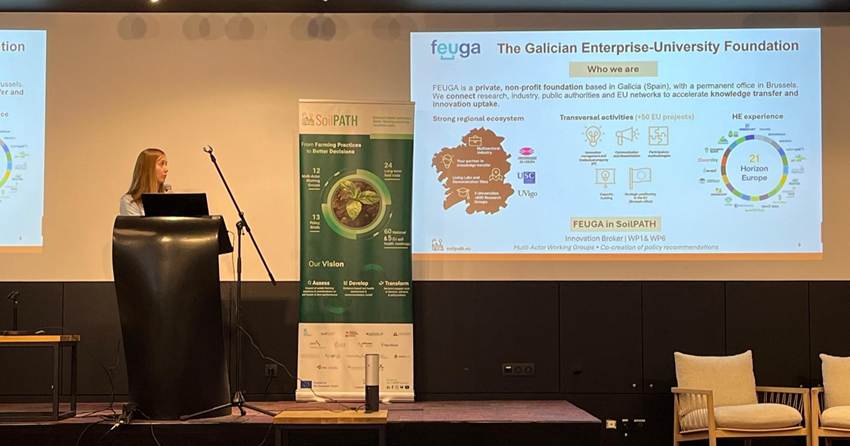
FEUGA will also lead the co-creation and validation of policy recommendations, leading to a set of 13 policy briefs – documents aimed at drawing policymakers’ attention and provide them with access to the most up-to-date sources of information. In addition, it will organize the Global Multi-Actor Event, an international meeting to share the project’s key findings and lessons learned.
UVigo will assess the impact of farming practices
The University of Vigo, through its Department of Plant Biology and Soil Sciences, led by researcher David Fernández Calviño, will contribute to the scientific development of the project, leading Work Package 2 (WP2).
The team will study the individual impact of different farming practices on soil health and environmental sustainability, collecting data that will provide a better understanding of how crop management decisions can affect soil condition.
Ghent hosts SOILPATH’s kick-off meeting
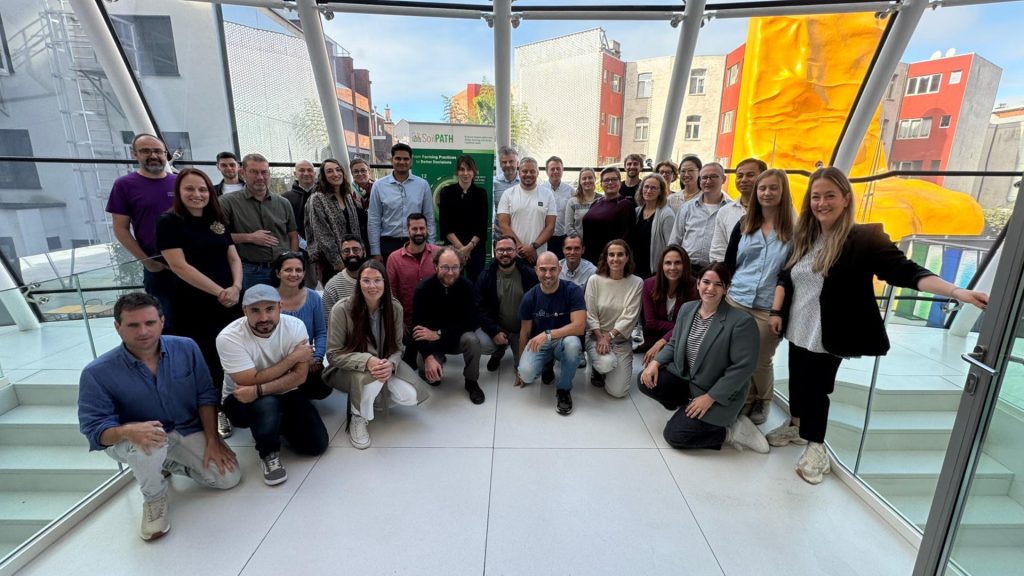
On 22 and 23 September 2026, the 17 SOILPATH partners met in Ghent (Belgium) fot the project’s Kick-off Meeting.

Over the two-day meeting, the partners discussed SOILPATH’s objectives and lines of work, addressed coordination across the different work packages, and defined the first tasks and next steps.
This meeting marks the beginning of a project that will run until 2031, bringing together research, knowledge from the field and stakeholder participation to advance farming practices that contribute to maintaining and improving the health of European soils.