Generative AI in Horizon Europe
Generative AI is no longer just a stylistic tool. It is becoming an invisible infrastructure within the European funding system, operating at two critical nodes of the Horizon Europe cycle:
- Proposal preparation.
- Evaluation and, increasingly, the scientific process as well.
As a result, a structural paradox arises: AI can reduce transaction costs in an already congested system, yet at the same time it can strain trust, confidentiality, and scientific integrity if it is not properly regulated.
The warning signs are evident. In 2025, Science|Business reported that the growing use of generative AI could be behind the rise in applications for certain calls, with success rates dropping to as low as 2% in some cases. In an ecosystem where every percentage point matters, this is far from an insignificant detail.
What Horizon Europe officially allows (and requires) in proposals
The EU Commission has moved from ambiguity to the written rule. The “Standard Briefing” for evaluators (v13.0, 01/12/2025), includes the disclaimer found in the application forms (Part B): makes it clear that applicants may use generative AI, but they must review and validate any generated content and, above all, ensure transparency: they must indicate which tools were used and how; provide a list of sources (including those generated by AI); and carefully monitor the risk of plagiarism.
Moreover, the text emphasizes that the applicant remains fully responsible for the content, including parts produced by AI. In other words, the Commission is shifting the technical risk of AI use onto the applicant, who must verify the accuracy and validity of AI-generated content and citations, correct errors and inconsistencies, provide a list of sources, including those generated by the tool, and carefully review potential plagiarism.
The same document adds an important note aimed at reducing fear or stigma: the use of AI in the draft “should not be considered cause for penalizing” a proposal.
This ties in with the practical warning issued by the Dutch RVO service: failure to comply with the programme’s AI guidelines may render a proposal “ineligible.” It explicitly states that a standard form (CSA) requires accountability, transparency, a list of sources, and caution regarding plagiarism.
AI also in the evaluation (there is already an investigation by the Ombudsman)
The debate has escalated because AI is not only being used by applicants. The European Ombudsman opened case 2979/2025/MIK (04/02/2026) to examine the systemic dimension: what rules exist on the use of AI by external evaluators, and how transparent they are towards proposal authors. The trigger was a complaint by a Polish company concerning a proposal submitted to the European Innovation Council (EIC Accelerator), regarding the potential use of AI by evaluators to draft or edit reviews and conduct “background research,” with additional concerns about confidentiality.
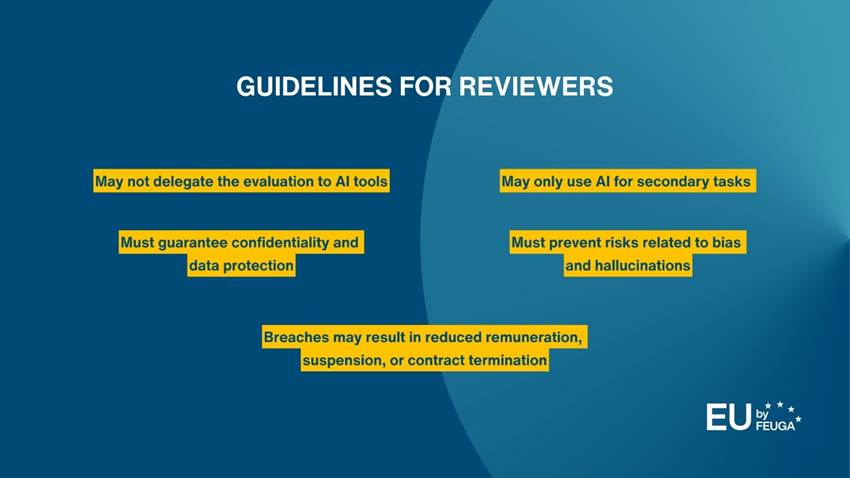
Here, the briefing material is crystal clear. Slide 26 introduces a clearly defined line:
Reviewers:
- May not delegate the evaluation to AI tools.
- May only use AI for secondary tasks (e.g., gathering contextual information).
- Must guarantee confidentiality and data protection.
- Must prevent risks related to bias and hallucinations.
- Breaches may result in reduced remuneration, suspension, or contract termination.
In addition, the confidentiality section explicitly warns that the use of generative AI tools (particularly online services) may constitute a breach of contractual confidentiality obligations.
Why Generative AI “fits” into the system: cost and time pressures
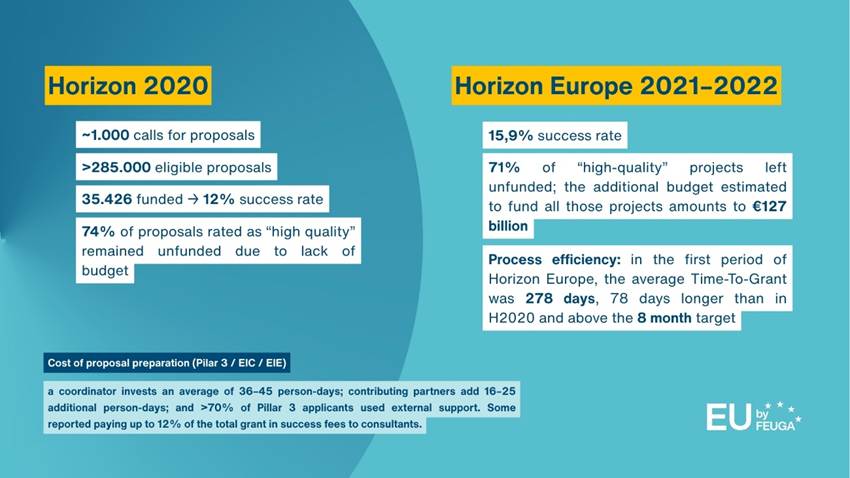
Generative AI is gaining ground because the system is already burdened with high transaction costs. The Align, Act, Accelerate report (European Commission expert group, 2024) provides some very interesting metrics:
- Horizon 2020: ~1,000 calls for proposals; over 285,000 eligible proposals; 35,426 funded → 12% success rate; and 74% of proposals rated as “high quality” remained unfunded due to lack of budget.
- Horizon Europe 2021-2022: 15.9% success rate, with 71% of “high-quality” projects left unfunded; the additional budget estimated to fund all those projects amounts to €127 billion.
- Cost of proposal preparation (Pillar 3 / EIC / EIE): a coordinator invests an average of 36–45 person-days; contributing partners add 16–25 additional person-days; and over 70% of Pillar 3 applicants used external support. Some reported paying up to 12% of the total grant in success fees to consultants.
- Process efficiency: in the first period of Horizon Europe, the average Time-To-Grant was 278 days, 78 days longer than in Horizon 2020 and above the eight-month target.
Under this level of pressure, it makes sense that generative AI is used to speed up writing, structure impact sections, or handle formatting. The “price”, however, is that if AI is used without traceability, the risks increase: fabricated citations, inadvertent plagiarism, or information leakage (and, for companies, even compromising patentability if sensitive ideas are uploaded to an external system, as warned by RVO).
CONCLUSIONS
Generative AI is not entering a stable system, but one that is already under strain. Under Horizon 2020, more than 285,000 proposals were submitted and only 12% received funding. In Horizon Europe (2021–2022), 71% of projects evaluated as “high quality” were left unfunded, and an additional €127 billion would be required to finance all that uncovered excellence.
In this context, if AI reduces the cost of drafting proposals and increases the volume of applications (as some analyses suggest, with success rates reportedly falling to as low as 2% in certain calls for proposals) the impact will not be marginal: it may alter the very design of the process.
The Commission has responded by regulating the use of AI and safeguarding the integrity of evaluation. But the question is no longer just how to use it; it is whether the application and evaluation model we know will remain viable in an environment where automation reduces barriers to entry. AI does not replace excellence, but it may reshape the rules of competition for European funds.