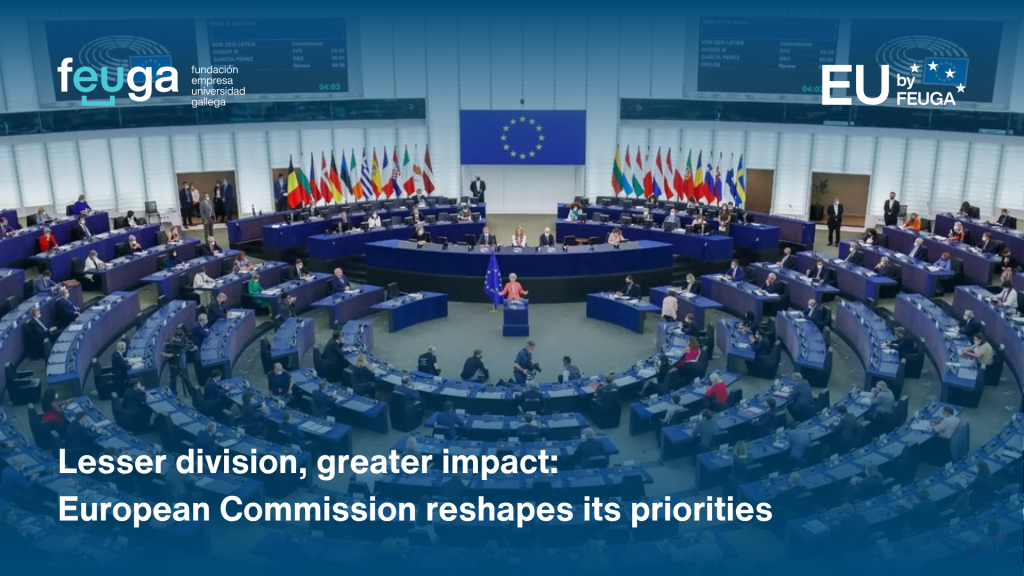
Internal reform points towards a more cross-cutting, selective and data- and AI-driven approach to management.
An internal working document from the European Commission, accessed by FEUGA, offers a rare insight into how the institution itself is assessing its challenges and considering changes to the way it operates. Against a backdrop of growing political pressure, increasing operational demands and an increasingly complex geopolitical environment, the document sets out lines of thinking that could shape the Commission’s internal reform.
Entitled “Large-scale review of the European Commission. Recommendations by the 15 workstreams”, the document is dated 13 July 2026 and brings together recommendations from 15 working groups as a basis for the final report of the Commission’s large-scale review.
According to the introductory letter by Piotr Serafin, Commissioner for Budget, Anti-Fraud and Public Administration, more than 150 Commission staff have been involved in the internal review since November 2025. The document brings together almost 100 recommendations aimed at strengthening the institution’s purpose and values, leadership, talent management and collaboration, as well as the functioning of Directorates-General, agencies and the Commission’s presence in Member States. It also addresses key areas such as innovation, artificial intelligence, administrative simplification, regulatory compliance, impact assessment and financial management.
For the Galician R&I ecosystem, the interest lies in the indirect implications of this reform. The Commission that emerges from this process will also be responsible for designing future programmes, setting strategic priorities, managing funding instruments, assessing results and impact, and engaging with universities, companies, technology centres, public administrations and knowledge-transfer organisations.
A more politically driven Commission
The document starts from a clear premise: the Commission’s role has changed significantly over the past two decades, moving from more traditional administrative and regulatory functions towards a more political and geopolitical role, particularly in coordinating European responses to crises, emergencies and strategic challenges (from COVID-19 and the war in Ukraine to economic crises and relations with international actors).
This increase in responsibilities calls for a review of structures, resources and ways of working. This is where one of the central concepts of the review comes into play: One Commission, a less fragmented institution, with fewer divisions between Directorates-General and a more shared understanding of its priorities.
The document itself notes that, when there is no clear common purpose, staff tend to identify more strongly with their DG or service than with the Commission as a whole. This can reinforce internal competition and limit collaboration across policy areas.
This has practical implications for those working with European projects. Many EU policies now operate at the intersection of research, industry, climate, energy, digitalisation, cohesion and competitiveness. As a result, proposals will increasingly need to explain more clearly what problem they address, which actors they bring together and how they contribute to European priorities.
Less accumulation, more selection
The review proposes using the Commission’s common purpose to prioritise resources, budget, staffing and organisational structures, distinguishing between essential functions, legacy activities that may no longer be central, and emerging priorities that will require greater capacity, such as defence and security, social resilience, digital innovation and artificial intelligence.
This classification points to a broader shift: the Commission appears to recognise that it cannot continue adding responsibilities without a clearer allocation of resources. In the section on discontinuation and prioritisation, the document notes that, between January 2021 and June 2025, the Commission identified a need for an additional 1,666 full-time equivalent staff to implement 87 legislative proposals, while the co-legislators granted only 9% of those resources.
AI, simplification and a new way of working
Artificial intelligence features prominently in the document, which recognises its growing role in the Commission’s day-to-day work and calls for investment in skills, tools and infrastructure, staff training and internal governance aligned with the institution’s public mission and values.
The most concrete proposal is an AI-augmented workforce, in which every staff member would have access to an AI Helper integrated into the Commission’s data, systems and workflows. The assistant would support searches, analysis, drafting and institutional knowledge management, while retaining human responsibility and oversight.
This shift could affect the entire lifecycle of European programmes, from policy design to implementation, monitoring and evaluation. As a result, data quality, traceability, consistency between objectives, activities and indicators, and the ability to explain results clearly will become increasingly important.
Simplification emerges as the other major operational priority. The document describes increasingly burdensome internal processes, overlapping tools, duplicated requests for information and growing reporting and compliance requirements. It proposes turning simplification into a continuous management practice.
Measures under consideration include shortening approval chains, reviewing recurring reports with limited added value, creating channels for staff to suggest simplifications, testing solutions before scaling them up and adopting risk-based approaches.
For beneficiaries of EU funding, well-designed simplification could reduce administrative burdens and eliminate duplication. But it could also mean greater emphasis on results, closer monitoring of impact and less room for poorly defined projects. In this sense, useful simplification does not mean asking for less, but asking better: clearer, proportionate requirements focused on what genuinely creates value.
What does this mean for Galicia?
The internal review does not immediately change the rules of Horizon Europe, Interreg, LIFE, Digital Europe or the future FP10. It does, however, provide useful signals about the direction in which the institution is moving.
The first is greater cross-cutting integration. If the Commission wants to operate in a more integrated way, projects capable of connecting research, business, territories, public policy and societal capacities are likely to be better positioned.
The second is the growing role of AI and data in European public administration. This will require clearer, more traceable and more robust proposals, particularly when it comes to indicators.
The third is greater pressure to demonstrate impact. A Commission seeking to allocate resources more selectively and reduce low-value activities is also likely to pay closer attention to which projects can deliver and substantiate meaningful results.
The fourth is the importance of anticipating policy conversations before they become calls for proposals. This is particularly relevant for an ecosystem such as Galicia, which needs to position its capabilities within increasingly cross-cutting European agendas.
This also directly affects the role of organisations supporting European projects. Tasks such as proposal writing, document preparation and certain management activities will become increasingly automatable. Both AI and companies with the capacity to invest in proprietary tools are already entering this space.
The differentiating value today lies in understanding the European agenda, identifying the priorities taking shape within the Commission, translating the capabilities of the Galician ecosystem into this political and technical language, building meaningful partnerships and helping universities, technology centres, companies and public administrations reach European funding opportunities from a stronger position.
This is where FEUGA’s role goes beyond project management. Its added value lies in acting as an expert agent for knowledge transfer, European connection and strategic advice to the Galician R&I ecosystem.
FEUGA’s Brussels office further strengthens this capacity by enabling the organisation to follow policy discussions before they translate into programmes, exchange perspectives with European networks and identify shifts in political language before they formally reach funding instruments.
The Commission to come
The internal document portrays a Commission that is increasingly aware of its own constraints and tensions: more responsibilities, limited resources, a need for greater integration, a stronger focus on AI, simplified processes and a more results-oriented approach.
For the Galician European funding ecosystem, this means preparing projects that are more closely aligned with real European priorities, stronger in terms of data, clearer on impact and better able to connect areas that could previously be addressed separately.
Competition for European funding will remain high. Part of the difference will lie in understanding more clearly where the institution designing and managing these funding opportunities is heading.