EU Framework Research Programme: a brief history
The European Union Framework Programmes for Research (FP) are a set of funding instruments launched in the early 1980s within the EU’s research and technological development policy. Their goal is to strengthen the scientific and technological foundations of the Union’s industry by creating a European Research Area in which researchers, scientific knowledge and technologies can circulate freely, thus contributing to boosting the competitiveness of the European Union on a global scale.
The first framework programme was established in 1983 for a four-year period. Since then, successive programmes have continuously provided financial support for the implementation of EU research and innovation policies. They have also increased their financial allocations in each period and adjusted their focus to address the socioeconomic needs and contexts of each moment.
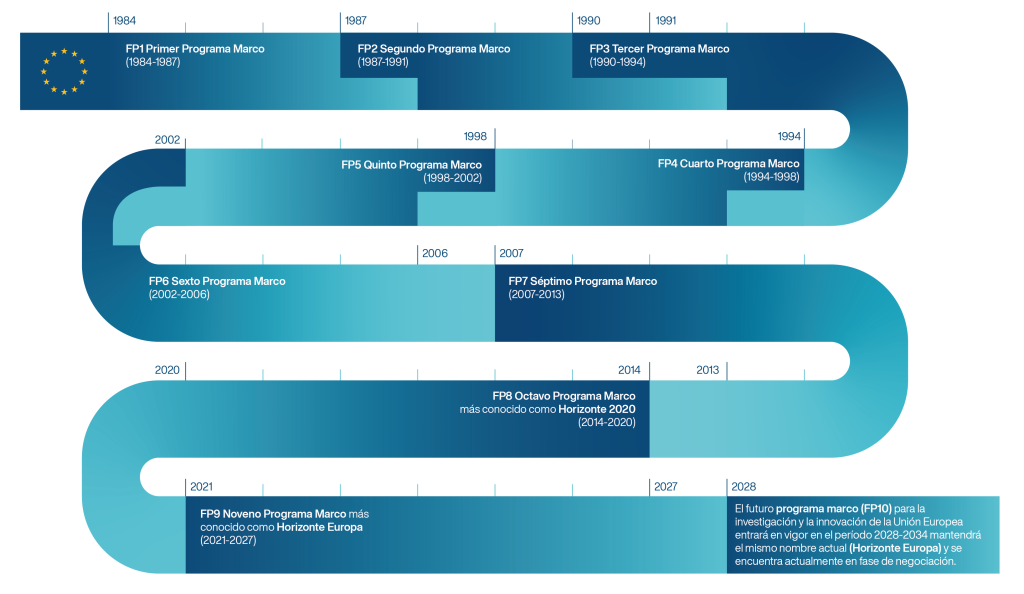
(Original infographic, information source: European Commission)
Since 1984, when Spain began participating in the first framework programme, the country has gradually established itself as one of the main actors in the European Framework Programmes for Research and Innovation. With modest beginnings but steady growth during the early editions, the major leap occurred in the Seventh Framework Programme (2007–2013), when Spain secured an 8.3% return on funds, with an upward trend that increased to 10.4% in Horizon 2020 and has continued in the current Horizon Europe programme (FECYT data).
At the national level, Galicia is emerging as a region with strong dynamism in the European ecosystem. It is currently the 6th autonomous community in overall funding attraction and has achieved significant progress in Pillar 2 (Global Challenges and European Industrial Competitiveness), where it rose from 9th to 6th position between Horizon 2020 and Horizon Europe. Up to June 2025, Galician entities have obtained €161.6 million in Horizon Europe, with 122 organisations participating in 468 approved projects out of 2,300 proposals submitted. This represents a success rate of 20.5%, higher than the global Horizon Europe success rate of 15%, according to data from the Xunta de Galicia.
The European Commission now proposes increasing the budget of the next Framework Programme (FP10) to €175 billion (compared with €95.517 billion in the current programme), reinforcing its status as one of the most powerful international funding sources for R&D&I and presenting a major opportunity for Galician entities seeking to attract European funds.
Horizon Europe: the major European programme for R&D&I funding
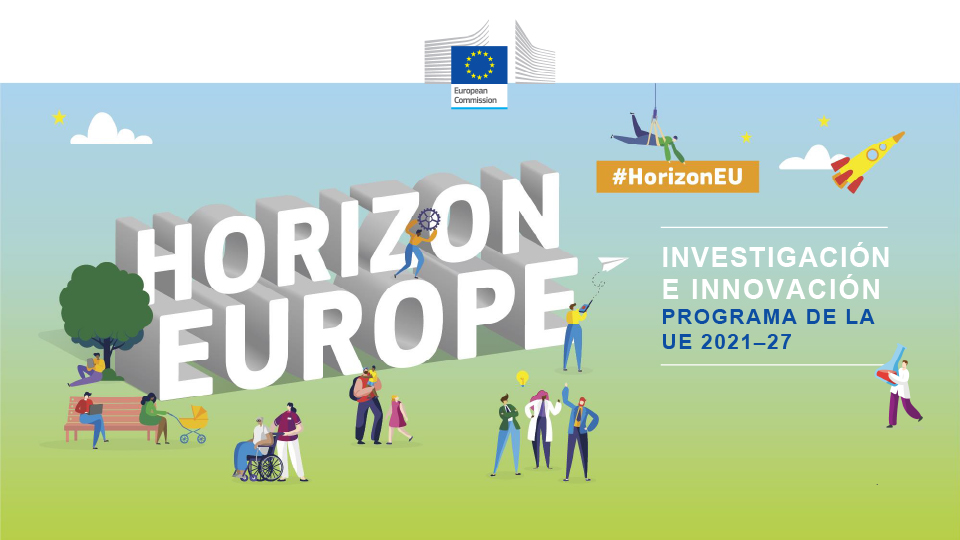
Horizon Europe is the current EU Framework Programme for Research and Innovation for the period 2021–2027. It provides European institutions with diverse funding instruments for R&D&I activities within a complex structure based on three complementary pillars, which must be well understood in order to identify opportunities for our R&D&I projects.
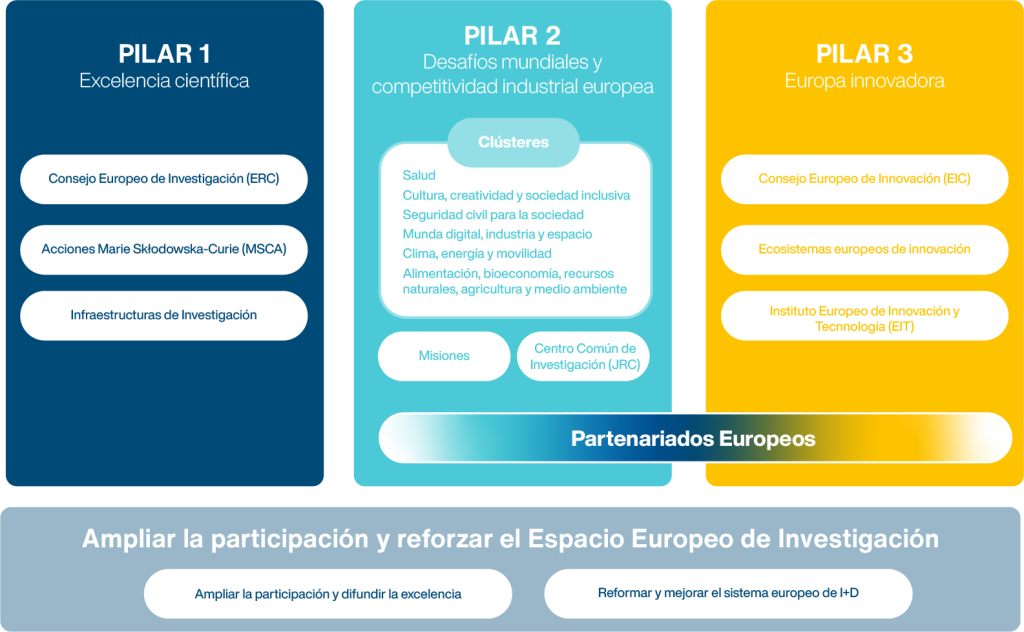
(Original infographic, information source: CDTI)
Pillar I: Excellent Science – Leading Fundamental Research
Pillar I, “Excellent Science,” funds cutting-edge research projects led by individual researchers through the European Research Council (ERC). It also supports mobility (including academic and non-academic exchanges), training and professional development of researchers through the Marie Skłodowska-Curie Actions (MSCA) and promotes the development and access to top-level Research Infrastructures to strengthen research and innovation in Europe. Overall, the success rate for Pillar I calls during 2021–2024 is around 15%, matching the programme’s overall rate.
Pillar II: Global Challenges – Participation in Thematic Clusters
Pillar II, “Global Challenges and European Industrial Competitiveness,” funds research and innovation addressing both EU social challenges and industrial competitiveness objectives. This pillar is structured around six thematic “Clusters” covering strategic areas for Europe such as health, climate change, energy, mobility, security, digitalisation, materials and the bioeconomy. These are implemented through collaborative international projects involving partners from different countries. Additionally, six missions operate similarly, addressing specific and ambitious challenges such as fighting cancer, adapting to climate change or developing climate-neutral smart cities. The success rate in these calls is slightly above the programme average, at around 18%.
Part of the funding also supports European partnerships, which design specific financing tools through public-private partnerships known as “European Partnerships.” These are collaborative instruments between the European Commission, Member States, and public or private actors aiming to address strategic challenges through joint resource mobilisation, aligned R&D&I agendas and market-oriented results. They fall under three main categories (co-funded, co-programmed and institutionalised). Their purpose is to concentrate efforts to accelerate the green transition, digitalisation, advances in health, the bioeconomy or sustainable mobility, among other priorities. These alliances allow access to additional funding, influence European strategic priorities and reinforce regional specialisation, making participation a key opportunity for Galicia by strengthening international networks, increasing financial returns and positioning regional actors in leading consortia. In this case, success rates generally reach around 20% in 2024, though with significant variation depending on the partnership.
Pillar III: Innovative Europe – Disruptive Innovation and Innovation Ecosystems
Pillar III focuses on innovation, funding projects that span from research to market uptake, with particular emphasis on high-potential startups and SMEs. Its aim is to stimulate the transfer of scientific knowledge into innovative companies, support the creation of new technology-based products and services, and promote disruptive innovation through tools such as the European Innovation Council (EIC) and the European Innovation Ecosystems (EIE). EIC calls stand out for their low success rate compared with the programme average—around 8% in 2024—while the EIE programme performs slightly above the average, at 18%.
Horizontal programmes: widening participation and the European Research Area
While the three pillars of Horizon Europe address specific objectives (scientific excellence, global challenges and disruptive innovation), the programme also includes a transversal pillar acting as a strategic layer reinforcing the overall EU R&D system beyond any particular area. The WIDERA programme fulfils this function by promoting widening participation, reducing regional R&D gaps and strengthening the European Research Area (ERA) through capacity building, institutional reforms and scientific cooperation. These instruments do not belong to a specific thematic area; instead, they support and complement all pillars by addressing structural needs affecting the entire European science and innovation system. Notably, WIDERA success rates are significantly higher than those of the main pillars (25% vs. a 15% Horizon Europe average in 2024).
Keys to Participation in Horizon Europe
Competitive access to European programmes requires a clear strategy, early preparation, and effective integration into the regional support ecosystem.
The first lever of success is building regional and international networks. Participation in events and information days is an essential starting point for establishing these networks and entering the European ecosystem. Engagement in European partnerships according to strategic areas of interest is also increasingly relevant.
In such a competitive environment, previous experience is crucial. Therefore, entities without experience should initiate their international scientific-technological activity alongside leading organisations in their environment that already have experience in Horizon Europe. The enterprise–university tandem and the integration of scientific-technical capacities from various regional actors are particularly important in Pillar II and in large consortia.
Additionally, it is advisable for newcomers to begin through more accessible instruments (e.g. cascade funding), which allow them to build a solid track record and familiarise themselves with European processes. The new programming period focuses on “newcomer-friendly” and “SME-friendly” calls, which encourage the participation of SMEs, start-ups, NGOs and small public administrations (e.g. small municipalities) in Horizon Europe.
As capacities mature, the choice of funding instrument should match technological readiness and organisational size: startups and spin-offs may look to EIC Accelerator, EIC Transition or WIDERA Pre-Accelerator; more consolidated and experienced entities may opt for European Partnerships or research and innovation actions under Pillar II. This selection must be further aligned with the sector or thematic area of interest, ensuring direct consistency with the priorities defined in each call, especially those not based on a bottom-up approach (mainly found in Pillars I and III).
Finally, specialised training and information are determinant factors. A wide range of courses and support structures are available to learn about the programme’s structure and opportunities, prepare competitive proposals, and understand the rules for implementation and reporting of approved projects.
Conclusions
During the first half of Horizon Europe 2021–2024, Galicia has consolidated an exceptional upward trajectory in the European research and innovation ecosystem, achieving a significant improvement compared with H2020 and doubling its financial return. This upward trend, combined with Spain’s strong leadership in Horizon Europe and the expected increase in funding in the new framework programme (FP10), positions Galicia with institutional advantages that, together with its recognised sectoral specialisations (biotechnology, marine resources, health, digital, etc.), create a historic window of opportunity for establishing the region as a European innovation benchmark in 2028–2034.
Step by step, the newly published 2026–2027 funding opportunities represent a substantial volume of resources that could position Galicia favourably for future programmes, providing more than €14 billion in competitive funds accessible to Galician entities that implement disciplined preparation strategies, build proactive international networks and, above all, take advantage of the support services offered by the ecosystem and collaboration with leading agents.
In conclusion, ecosystem support is essential to maximise the participation of Galician entities in European programmes. Network-building and technological alliances, specialised training and intelligent selection of instruments constitute the roadmap necessary for Galicia to significantly increase its participation and success in European R&D&I funding programmes, helping shape an advanced and dynamic society that attracts and retains talent, fosters high-value employment opportunities and ultimately improves the quality of life of Galician society.
New Opportunities: publication of the Horizon Europe 2026–2027 calls
In 2026 and 2027, with a budget of €14 billion, a wide range of funding opportunities opens across all Horizon Europe lines, with calls covering everything from disruptive research to applied innovation and cross-border cooperation. The Work Programmes published this December 2025 are available on the EU Funding & Tenders Portal and contain all relevant information on these calls.
Need support?
Operating from Galicia and Brussels, FEUGA provides comprehensive advisory services throughout the entire lifecycle of the calls, acting as a regional information point for our collaborators. With a team of 20 experts in European programmes, we facilitate access to such a complex and competitive programme as Horizon Europe.
Contact us for more information: proyectoseuropeos@feuga.es